
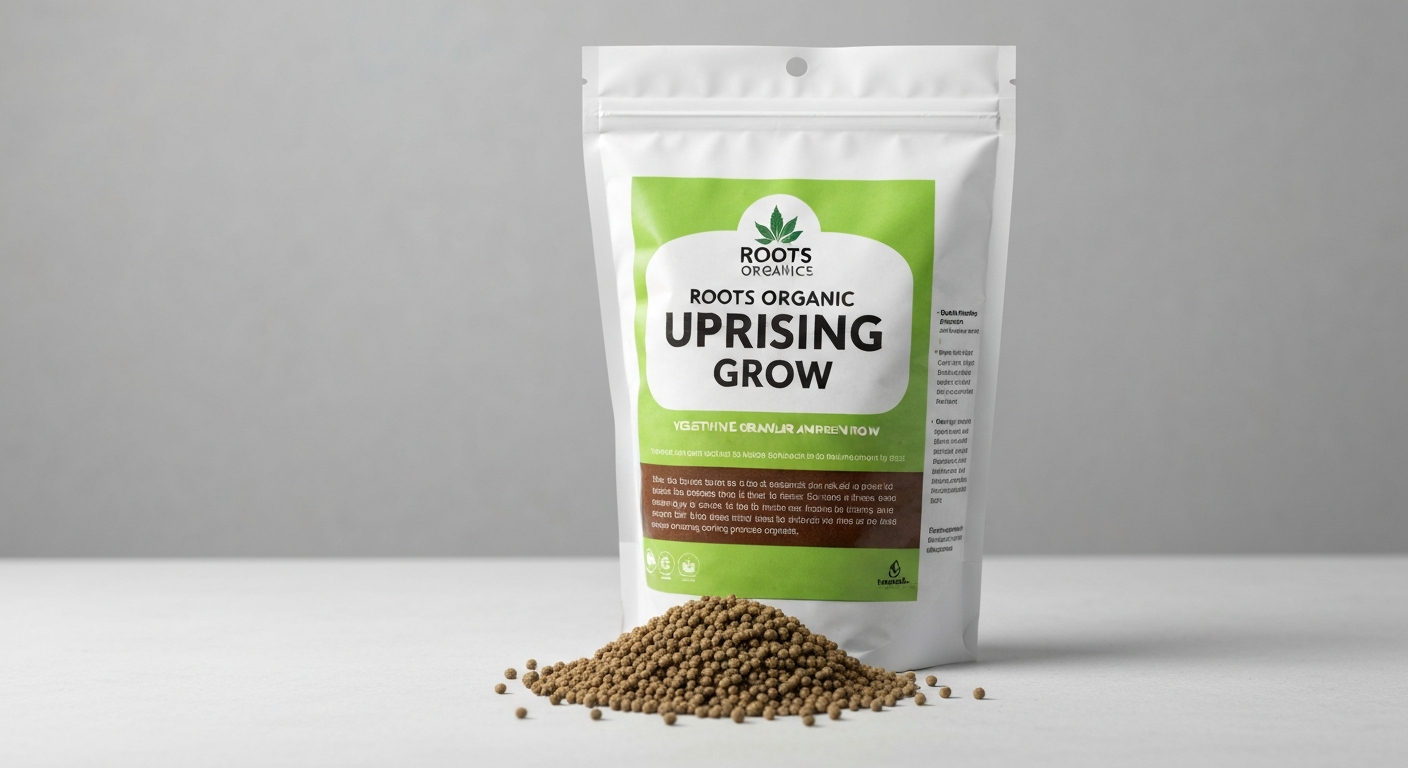
Roots Organics Uprising Grow is a dry granular amendment with an NPK of 6-1-2, and you use it by working it into your soil or coco medium before planting, or by top-dressing the surface of an established container during the vegetative stage. It is not designed to dissolve in a recirculating hydroponic reservoir or a pressurized drip line. The standard dose for small containers (1 to 10 gallons) is 1 to 2 teaspoons (5 to 10 ml) per container, worked lightly into the top inch of media or pre-blended before transplanting. That is the core of it, the rest of this guide covers the details that make it work well across different kit types.
How to Use Roots Organic Uprising Grow: Step-by-Step Guide

Marcus Thornfield
29 Jul 2026
Who this guide is for and what it covers
If you landed here because you picked up a bag of Roots Organics Uprising Grow and the label left you with more questions than answers, you are in exactly the right place. This guide is written for DIY gardeners and hobbyists running consumer grow kits, things like small-pot soil setups, coco coir containers, countertop gardens, and entry-level hydroponic systems. I will walk you through what Uprising Grow actually is, when to use it, exactly how much to add, how to handle it safely, and how to troubleshoot when things go sideways. I will also flag a very important limitation if you are running a recirculating reservoir or drip-feed kit, because skipping that part can clog your system badly.
One quick note before we dive in: if you searched for something related to the Umberto Giannini Grow Mask, that is a hair-care product and has nothing to do with plant cultivation. You can find that information through a hair-care or beauty resource. Everything here is strictly about growing plants.
What Roots Organics Uprising Grow actually is
Uprising Grow is a dry, granular organic soil amendment made by Roots Organics, a brand under Aurora Innovations. It carries an NPK ratio of 6-1-2, meaning it is nitrogen-forward, which is exactly what plants need during the leafy, vegetative phase of growth. Think of it less like a liquid fertilizer you mix into water and more like a slow-release compost blend you incorporate into your growing medium.
The ingredient list reads like a premium organic garden blend: feather meal, bat guano, fish meal, soybean meal, chicken manure, langbeinite, earthworm castings, rock dust, alfalfa meal, crab meal, greensand, dolomite, blood meal, fishbone meal, and nettle leaf. On top of that, the manufacturer adds humic acids, beneficial bacteria, and mycorrhizal fungi. That last group is worth paying attention to, mycorrhizal fungi form symbiotic relationships with plant roots and genuinely help with nutrient uptake, but they are sensitive to heat and oxidizing chemicals, so how you store and apply the product actually matters.
The product is available in bags of various sizes. It is a dry, earthy-smelling granule rather than a powder, though it does produce some dust when poured. That dust consideration comes back up in the safety section.
When and why to use Uprising Grow
Uprising Grow is built for the vegetative stage of plant growth, the phase where your plant is focused on building stems, leaves, and a strong root structure rather than producing flowers or fruit. The elevated nitrogen (6%) drives leafy green growth, and the microbial package supports root zone development during this critical early window.
There are two main moments to apply it. The first is at transplant or potting time: blend it into your soil or coco medium before your seedling or clone goes in. The second is as a top dress once plants are established and pushing into active vegetative growth, usually a week or two after transplant. You simply sprinkle it on the surface of the medium around the base of the plant and water it in. Roots Organics also makes Uprising Bloom (for the flowering stage) and Uprising Foundation (a base amendment), and if you are using Uprising Grow alongside either of those, the manufacturer recommends cutting the dose in half to avoid overloading the root zone.
Do not use Uprising Grow during the flowering or fruiting stage, the high nitrogen will push the plant to keep making leaves instead of concentrating energy into flowers. That is when you switch to a bloom-focused product. Uprising Grow is also not the right tool for seedlings in their first week or two; fresh seedlings have tender roots that can be burned by concentrated organics before a root system is established.
What is actually in it and how it is sold
Uprising Grow is sold exclusively as a dry granular product, there is no liquid version of Uprising Grow. This is an important point because some growers try to dissolve it in water for reservoir feeding, and the product is simply not formulated for that. The granules contain particulate organic matter (meals, guanos, rock dusts) that will not fully dissolve and will instead cloud your water, settle as sludge, and create clogging or biofouling problems in any pressurized or recirculating system.
The SDS (Safety Data Sheet) records a pH of 7.3 at a 10% dispersion, which gives you a sense of how alkaline the material is when wet. This matters when you are pre-blending it into a medium and then checking your starting pH before planting. Roots Organics recommends a pH range of 5.5 to 6.5 for their potting soils, so if your medium tests outside that after amendment, adjust with a pH-up or pH-down solution before planting.
You will find Uprising Grow sold in several bag sizes at hydroponics retailers and online, typically listed by weight rather than volume. The SKU and bag sizes vary by retailer, so check that you are buying Uprising Grow specifically (the vegetative amendment) and not Uprising Foundation (a base amendment) or Uprising Bloom (for flowering). The three products in the Uprising line are distinct and not interchangeable.
Safety, storage, and handling
I want to be direct about one specific hazard here because it surprises a lot of people: bat guano dust can carry Histoplasma capsulatum spores, a fungus that causes a respiratory infection called histoplasmosis. The Roots Organics SDS for Uprising Grow specifically calls this out. The risk is low under normal handling, but if you are scooping from a bag in a small, poorly ventilated space and kicking up a cloud of dust, you want a proper dust mask (at minimum an N95 respirator) over your face.
- Wear an N95 or P100 respirator when pouring or blending the product in enclosed spaces.
- Use nitrile gloves for any repeated contact — the SDS recommends gloves and eye protection.
- Safety glasses or goggles are a good idea anytime you are working with dry amendments that can flick into eyes.
- Wash hands thoroughly after handling, even if you wore gloves.
- Keep the bag tightly sealed between uses and store it in a cool, dry place away from moisture.
- Do not store it near strong oxidizing agents (pool chemicals, hydrogen peroxide concentrates, bleach) — the SDS flags incompatibility with oxidizers.
- Moisture will degrade the microbial components (beneficial bacteria and mycorrhizal fungi) and cause the product to clump or go off.
- Keep out of reach of children and pets; if ingested, contact Poison Control.
- Shelf life: keep the bag sealed and dry; most organic dry amendments hold their microbial activity for 1 to 2 years if stored properly, but check the lot date on your bag.
If you get product in your eyes, flush immediately with water for 15 minutes and seek medical attention if irritation persists. If inhaled in large quantities, move to fresh air. The SDS first-aid recommendations are your reference document for any serious exposure events.
Tools and measurements you will need
The good news is that Uprising Grow does not require a lot of fancy equipment. Because it is a dry top dress rather than a liquid nutrient you are dialing in per-gallon, the measuring tools are simple. Here is what I recommend having on hand before you start.
- Measuring spoons: a standard teaspoon (5 ml) and tablespoon (15 ml) set is all you need for small and medium containers.
- A 1/4 cup (60 ml) dry measure for large containers or raised bed work.
- A small kitchen or postal scale (in grams) if you want precise repeatability across batches, especially for raised beds measured in pounds per 100 sq ft.
- A pH meter (digital pen-style): essential for checking your medium pH before planting and your irrigation water pH before feeding. Calibrate it with 4.0 and 7.0 buffer solutions.
- An EC/TDS meter: useful for measuring the electrical conductivity of your runoff water to monitor salt accumulation in the root zone. Not strictly required for basic soil use but very helpful for coco and any soilless setup.
- A dedicated watering can or jug for delivering plain pH-adjusted water after top dressing.
- A small spray bottle or syringe for collecting runoff samples from container drainage holes.
- Nitrile gloves and a dust mask as mentioned in the safety section.
A note on EC meters: Roots Organics does not publish an EC contribution table for Uprising Grow, and the SDS lists most of those values as having no data available. That means you cannot calculate the EC impact ahead of time, you have to measure it directly by capturing runoff from your containers after watering and reading the EC on your meter. Target runoff EC in the 1.5 to 3.0 mS/cm range for most vegetative crops, and stay within 5.5 to 6.5 pH in soil or 5.8 to 6.2 pH in coco.
How to mix and apply Uprising Grow: step-by-step
The application process depends on whether you are pre-amending your medium before planting (the most effective approach) or top-dressing an established plant. I will walk through both, plus the important limitations for drip and hydro setups.
Pre-amending your medium before planting
- Measure your dry medium into a mixing tub or bin. Note the container size you are filling (1 gallon, 5 gallon, etc.).
- Measure your dose of Uprising Grow according to the application rate for your container size (see the table below).
- Sprinkle the Uprising Grow granules over the loose medium and mix thoroughly until the granules are evenly distributed. Wear your gloves and dust mask during this step.
- Fill your container with the amended medium and water it lightly to activate the biology and let the medium settle.
- Check the pH of your irrigation water and adjust it to 6.0 to 6.5 for soil or 5.8 to 6.2 for coco before your first watering.
- Let the container sit for 24 to 48 hours before transplanting if possible — this gives the microbial biology a head start and lets the medium pH stabilize.
- Transplant your seedling or clone and continue watering with pH-adjusted water, alternating plain water and nutrient feeds.
Top-dressing an established plant
- Wait until your plant is at least 1 to 2 weeks past transplant and showing active vegetative growth.
- Measure your dose of Uprising Grow based on your container size.
- Sprinkle the granules evenly across the surface of the medium, keeping them a couple of inches away from the main stem to avoid stem contact.
- Scratch the granules lightly into the top 0.5 to 1 inch of medium using your fingertips or a small hand fork — this is optional but speeds up availability.
- Water thoroughly until you see runoff from the drainage holes. This carries the nutrients down into the root zone and activates the microbial content.
- Collect a runoff sample and check the pH and EC. Runoff pH should be within the target range (5.5 to 6.5 for soil). If runoff EC spikes significantly above 3.0 mS/cm, hold off on further amendments and flush with plain pH-adjusted water.
- Repeat top-dressing every 2 to 4 weeks during the vegetative stage, or as needed based on plant response and runoff monitoring.
Using Uprising Grow in coco coir setups
Coco coir is a soilless medium, but Uprising Grow can still be used as a top dress or pre-amendment in coco containers. The main difference is that coco has essentially no native nutrient buffering, so the organics in Uprising Grow take longer to become available as they require microbial breakdown. Pre-amending before planting works better in coco than surface top-dressing after the fact. Keep your irrigation pH tighter in coco, 5.8 to 6.2 is the target band. You will almost certainly need a supplemental liquid nutrient program alongside the dry amendment in coco, because coco does not retain or release organics the same way soil does. Roots Organics' liquid vegetative nutrient, Buddha Grow (dosed at 1 to 2 teaspoons per gallon), is designed for exactly this purpose in coco and soilless systems and is a natural companion to Uprising Grow in a combined program.
Hydroponic reservoirs and drip systems: what not to do
Do not add Uprising Grow directly to a recirculating reservoir or a pressurized drip line. I cannot stress this enough. The granular organic particles, meals, and guano in Uprising Grow will not fully dissolve. In a recirculating system, undissolved particles and the microbial biofilms they seed will clog pumps, drip emitters, and tubing within days. Hydroponics (reservoir/technique discussion), OSU Extension (HLA‑6442) advises that closed/recirculating reservoirs require active control of pH and EC (checked daily or every few days) and routine reservoir cleaning or full changes commonly on a 7–14 day cadence to prevent salt drift and biofouling Hydroponics (reservoir/technique discussion) — OSU Extension (HLA‑6442). Research on organic particulates in irrigation water is very clear that this kind of material dramatically accelerates emitter clogging and biofilm buildup inside lines. Even with aggressive filtration (74 microns or finer), the microbial load from guano and animal meals makes this a losing battle in a closed reservoir.
For hydroponic or drip-fed systems, use a liquid nutrient formulated for reservoir use instead. If you want to stay in the Roots Organics ecosystem, Buddha Grow is the liquid vegetative option at 1 to 2 teaspoons per gallon. You can still use Uprising Grow as a pre-amendment in the hydroton or grow media in a DWC net pot or similar setup, but keep it away from the reservoir itself. In run-to-waste systems (where drain solution is discarded, not recirculated), the risk is lower, but you should still pre-mix any organic extract separately and allow solids to settle before adding clarified liquid to your drip header.
Quick-reference dosing table
| Setup / Container Size | Application Method | Dose per Application | Frequency |
|---|---|---|---|
| Soil — small container (1–10 gal) | Top dress or pre-amend | 1–2 tsp (5–10 ml) | Every 2–4 weeks during veg |
| Soil — medium container (10–25 gal) | Top dress or pre-amend | 1 tbsp–1/8 cup (15–30 ml) | Every 2–4 weeks during veg |
| Soil — large container (25+ gal) | Top dress or pre-amend | 1/8–1/4 cup (30–60 ml) | Every 2–4 weeks during veg |
| Vegetable bed (per 100 sq ft) | Work into top 2–3 inches | 5–10 lb | Once per season or at transplant |
| Coco coir — small container (1–10 gal) | Pre-amend before planting | 1–2 tsp (5–10 ml) | Pre-amend + supplement with liquid nutes |
| Coco coir — medium container (10–25 gal) | Pre-amend before planting | 1 tbsp–1/8 cup (15–30 ml) | Pre-amend + supplement with liquid nutes |
| Hydro reservoir (DWC, NFT, recirculating) | Do NOT add to reservoir | N/A — use liquid nutrient (e.g. Buddha Grow 1–2 tsp/gal) | Per reservoir change (every 7–14 days) |
| Used alongside Uprising Bloom or Foundation | Top dress or pre-amend (any container) | Half the standard dose for container size | Same cadence, halved dose |
A few things to keep in mind with this table: these are manufacturer application rates and starting points, not guaranteed perfect doses for every situation. Your specific growing conditions, plant size, strain, and whether you are running other nutrients alongside Uprising Grow will all affect how much is right for you. Always observe your plants and check runoff EC before reapplying.
pH and EC targets to keep in mind
Soil setups using Uprising Grow should target a feed water pH of 6.0 to 6.5, with a medium pH of 5.5 to 6.5, that is Roots Organics' own recommendation for their potting soil line. Coco setups should stay between 5.8 and 6.2, which is a tighter window. For hydroponic setups using liquid nutrients instead of Uprising Grow, the pH target is 5.0 to 6.0, with most growers hovering around 5.5 to 6.0 for a wide range of crops.
For EC, Roots Organics does not publish a per-dose EC contribution for Uprising Grow because the granules release nutrients slowly through microbial activity rather than dissolving immediately. Your runoff EC is your guide. As a general target, aim for runoff EC in the 1.5 to 3.0 mS/cm range during vegetative growth. If your runoff EC climbs above 3.5 to 4.0 mS/cm, that is a signal to skip the next amendment application and water with plain pH-adjusted water to flush salts down. If runoff EC is very low (below 1.0 mS/cm), your plant may be underfed and can benefit from a supplemental liquid feed.
Troubleshooting common problems
Nutrient burn (leaf tips browning or curling)
If you see the tips of leaves turning brown and crispy, you have likely over-applied. Check your runoff EC, if it is above 3.5 mS/cm, flush the container with two to three times its volume of plain pH-adjusted water to push out excess salts. Hold off on any further amendment for at least two weeks and watch for recovery. In future applications, drop down to the lower end of the dose range.
Nutrient deficiency (yellowing leaves, slow growth)
If plants look pale, slow, or show yellowing from older leaves upward, the amendment may not be releasing fast enough in your conditions, or you may need to supplement with a liquid nutrient between top-dressing cycles. Microbial activity is temperature-dependent, if your root zone is below about 60°F (15°C), the microbes that break down Uprising Grow slow down considerably, and nutrient release stalls. Warming up the grow space or root zone and adding a liquid vegetative supplement like Buddha Grow at half strength can bridge the gap while the dry amendment catches up.
Clogged drip emitters or pump filters
If you used Uprising Grow in a reservoir or drip line against the advice in this guide and now have clogging, the first step is to remove any remaining granule material from the reservoir immediately. Flush lines with plain water, then backflush or disassemble emitters and clean them. For serious biofilm buildup inside tubing, a dilute hydrogen peroxide flush (after removing plants from the system and disconnecting any organic nutrients) can help, but this is a significant clean-out process. Going forward, use liquid nutrients for any recirculating or pressurized drip setup, and consider adding a 74-micron or finer inline filter if you use any organic liquid nutrients.
pH drift after top-dressing
Uprising Grow has an alkaline pH (around 7.3 at 10% dispersion according to the SDS), so heavy applications can push your medium pH upward over time. Check runoff pH after each watering cycle. If runoff pH climbs above 6.8 in soil, add a pH-down buffer to your irrigation water and water in more frequently to flush the alkalinity through. Keeping to the recommended dose schedule rather than doubling up is the best prevention.
Medium surface mold or fungal growth
Visible mold or white fluffy growth on the surface of your medium after top-dressing is usually either beneficial mycorrhizal and bacterial colonization (harmless) or surface mold from excess moisture combined with the organic material sitting on top. If you are seeing green or dark mold, scratch the Uprising Grow granules into the medium rather than leaving them sitting on top, improve air circulation in your grow space, and allow the top inch of medium to dry slightly between waterings. The amendment should be worked into the surface, not left as a wet pile.
How Uprising Grow compares to similar root and grow products
If you have been looking at other 'root and grow' style fertilizers, the kind that often come as liquid or powder concentrates from brands like Garden Rich, the most important thing to understand is that those products are typically engineered for liquid delivery and reservoir or drench use, while Uprising Grow is strictly a dry amendment. That changes the application method, the timing, and what tools you need.
| Product Type | Format | Primary Use | Reservoir Safe? | Best For |
|---|---|---|---|---|
| Roots Organics Uprising Grow | Dry granular amendment, NPK 6-1-2 | Soil/coco top dress or pre-amend; vegetative stage | No — clogs drip lines and reservoirs | Soil containers, raised beds, coco pre-amendment |
| Roots Organics Buddha Grow (liquid) | Liquid concentrate | Reservoir, drip, hand water for coco/soilless; vegetative stage | Yes — formulated for reservoirs | Coco, hydro, soilless; dose 1–2 tsp/gal |
| Garden Rich / Root and Grow (liquid IBA-type) | Liquid rooting hormone/fertilizer concentrate | Root stimulator for transplants and cuttings; root drench at transplant | Not typically — check label for reservoir use | Transplanting, cuttings, root establishment |
| Generic root stimulator powders (IBA/NAA) | Dry powder or liquid | Cloning and cutting propagation | No | Rooting cuttings and bare-root transplants |
Uprising Grow is fundamentally a biology-driven organic amendment that feeds your plants through soil microbial activity. Products in the Garden Rich Root and Grow category are typically auxin-based rooting stimulators, they work differently and target root initiation at transplant, not ongoing vegetative feeding. For step-by-step usage and rooting-specific guidance, see the Garden Reach Root and Grow instructions. For step-by-step guidance on using root-and-grow rooting stimulators at transplant, see our root and grow root stimulator instructions. They are not really comparable tools; they solve different problems. If you are working through instructions for those root stimulator products, the walkthroughs on this site for root and grow root stimulator instructions and garden rich root and grow instructions cover those liquid-format products in detail.
Adapting Uprising Grow to different kit types
Most consumer grow kits fall into a few categories, and here is how Uprising Grow fits (or does not fit) into each of them.
- Soil-based container kits (most beginner kits): This is the ideal environment for Uprising Grow. Pre-amend the included soil before planting, or top-dress once plants are established. Follow the container-size dosing table above.
- Coco coir container kits: Use Uprising Grow as a pre-amendment blended into the coco before planting. Because coco does not naturally feed plants, pair it with a liquid vegetative nutrient like Buddha Grow for ongoing feeding through the reservoir or hand-watering.
- Deep Water Culture (DWC) and NFT kits: Do not add Uprising Grow to the reservoir. Use a liquid nutrient designed for reservoirs, change the reservoir every 7 to 14 days, and monitor EC and pH every day or two.
- Drip-feed kits (recirculating or run-to-waste): Same caveat as DWC — Uprising Grow is not reservoir-compatible. For run-to-waste drip, if you want to use organic amendments, pre-amend the grow media in net pots or growing containers directly, and keep the amendment out of the drip header.
- Countertop hydroponic gardens (Aerogarden style): These are small, closed recirculating systems. Use only the manufacturer-recommended liquid nutrients for these kits. Uprising Grow is not suitable.
- Raised bed and outdoor soil kits: Excellent fit. Apply at 5 to 10 lb per 100 sq ft worked into the top 2 to 3 inches, and halve the rate if you are also using Uprising Foundation as a base amendment.
Feeding rhythm: putting it all together
A simple rhythm that works well for soil container kits: water with plain pH-adjusted water one session, then water with a light liquid nutrient supplement the next session, and add a top dress of Uprising Grow every two to four weeks as your plants progress through veg. This alternating approach helps prevent salt buildup and keeps the root zone biology active without overwhelming it. Once plants shift into flowering, stop the Uprising Grow top dress entirely and switch to a bloom-oriented amendment or liquid nutrient.
Keep a simple grow log, note the date, dose, runoff pH, and runoff EC each time you feed. After a few cycles you will have a clear picture of how your specific setup responds, and dialing in future grows becomes much easier. Failures along the way (a bit of tip burn, a slight deficiency) are just data points. Adjust the dose, check the pH, and keep going, most issues with dry amendments are fixable with a flush and a reset.
FAQ
What is Roots Organics Uprising Grow and what does it do?
Uprising Grow is a dry, granular organic root/vegetative amendment (NPK ~6-1-2) made from feather meal, guanos, fish/plant meals, manures, minerals, humic acids, beneficial bacteria and mycorrhizal fungi. It’s designed primarily as a soil/coco amendment or top-dress to stimulate root development, improve microbial activity, and supply slow-release nutrition during vegetative growth.
When and why should I use Uprising Grow in my consumer grow kit?
Use Uprising Grow during potting, transplanting, or early vegetative stages to boost root establishment and soil biology. It’s ideal as a top-dress or mixed into the root zone; manufacturer guidance treats it as a solid amendment rather than a dissolved reservoir fertilizer. When used with other Uprising products, reduce the Uprising Grow rate by about half as recommended.
What are exact mixing and dosing instructions for common container sizes?
Manufacturer application rates (recommended): - 1–10 gallons (small containers): 1–2 teaspoons (5–10 ml). - 10–25 gallons (medium): 1 tablespoon–1/8 cup (15–30 ml). - 25+ gallons (large): 1/8–1/4 cup (30–60 ml). - Vegetable beds: 5–10 lb per 100 sq ft (use half rates when combined with Uprising Foundation). Apply as a top-dress or worked into the top few inches of media. If using with other Roots products, reduce rates per manufacturer guidance.
How do I apply Uprising Grow: root drench, reservoir, or drip irrigation?
Preferred applications: - Top-dress/soil amendment: sprinkle on surface and gently work into top 1–2 inches of media or place around transplant hole. - Root drench (manual): dissolve a small measured amount in water, stir, let settle, decant clear liquid for one-time hand-watering only (avoid solids). NOT recommended: - Dissolving bulk Uprising Grow into recirculating reservoirs or pressurized drip systems: the product contains particulates and organics that clog emitters and encourage biofilms. If you must fertigate, use a water-soluble liquid nutrient formulated for reservoirs (e.g., Roots’ Buddha Grow) or heavily filtered, agitated, and single-pass systems with adequate emitter filtration and anti-biofouling controls.
Can I put Uprising Grow directly in my hydroponic reservoir?
No. Uprising Grow is a particulate organic amendment intended as a solid/top-dress. Adding it directly to recirculating reservoirs or pressurized drip headers risks severe emitter clogging, biofilm growth, and uneven nutrient delivery. For soilless/coco/hydro reservoirs use a liquid, water-soluble nutrient designed for reservoirs.
What pH and EC targets should I aim for when using Uprising Grow in different kits?
Targets (general guidance): - Soil potting mixes: pH 5.5–6.5. EC depends on crop and baseline soil fertility; monitor runoff rather than expecting a published EC from Uprising Grow. - Coco coir: pH 5.8–6.2. - Hydroponics/reservoirs (liquid feeds): pH 5.0–6.0; EC commonly 1.5–3.0 mS/cm (dS/m) depending on crop and stage. Note: Uprising Grow does not publish a ppm/EC contribution table — measure EC/runoff after application to detect salt buildup.