
To grow a unicorn (or any similar water-expanding toy) in water, place the compact foam, sponge, or hydrogel figure into a container filled with enough plain tap water to fully submerge it. Leave it undisturbed for 24 to 72 hours, topping up the water if the level drops. Most small unicorn toys reach close to full size within 24 hours; larger figures need the full 72 hours. That is genuinely the whole process, but the details around container size, water amount, timing, safety, and what to do when things go wrong are worth reading before you start. For step-by-step guidance specific to this kit, see grow your own unicorn instructions.
Grow Unicorn in Water Instructions: Step-by-Step Guide

Marcus Thornfield
18 Jul 2026
What 'growing' a unicorn toy actually means
These toys are made from sodium polyacrylate or a similar superabsorbent polymer (SAP), sometimes formed into a compressed foam sponge shape. When you put them in water, the polymer chains absorb huge amounts of liquid and the toy swells up to many times its dry size. The 'magic' is just chemistry: one gram of dry SAP can absorb roughly 200 to 300 times its weight in distilled water, though tap water absorbs a little less because dissolved minerals (salts and ions) reduce the swelling capacity. You are not actually growing anything alive. No seeds, no soil, no nutrients. You are rehydrating a compressed polymer shape until it reaches its molded size.
It is worth knowing upfront that 'Grow-Your-Own Unicorn' is sold as at least three completely different kit types: (a) the water-expandable compressed foam or hydrogel figure covered in this article, (b) a plant-and-seed terrarium kit where a unicorn pot or container holds real soil and seeds, and (c) a crystal-growing powder kit. The water-submersion instructions here only apply to type (a). If your packaging mentions seeds, soil, or crystals, you need a different set of instructions entirely. Check the packaging before you do anything.
Supplies checklist before you start
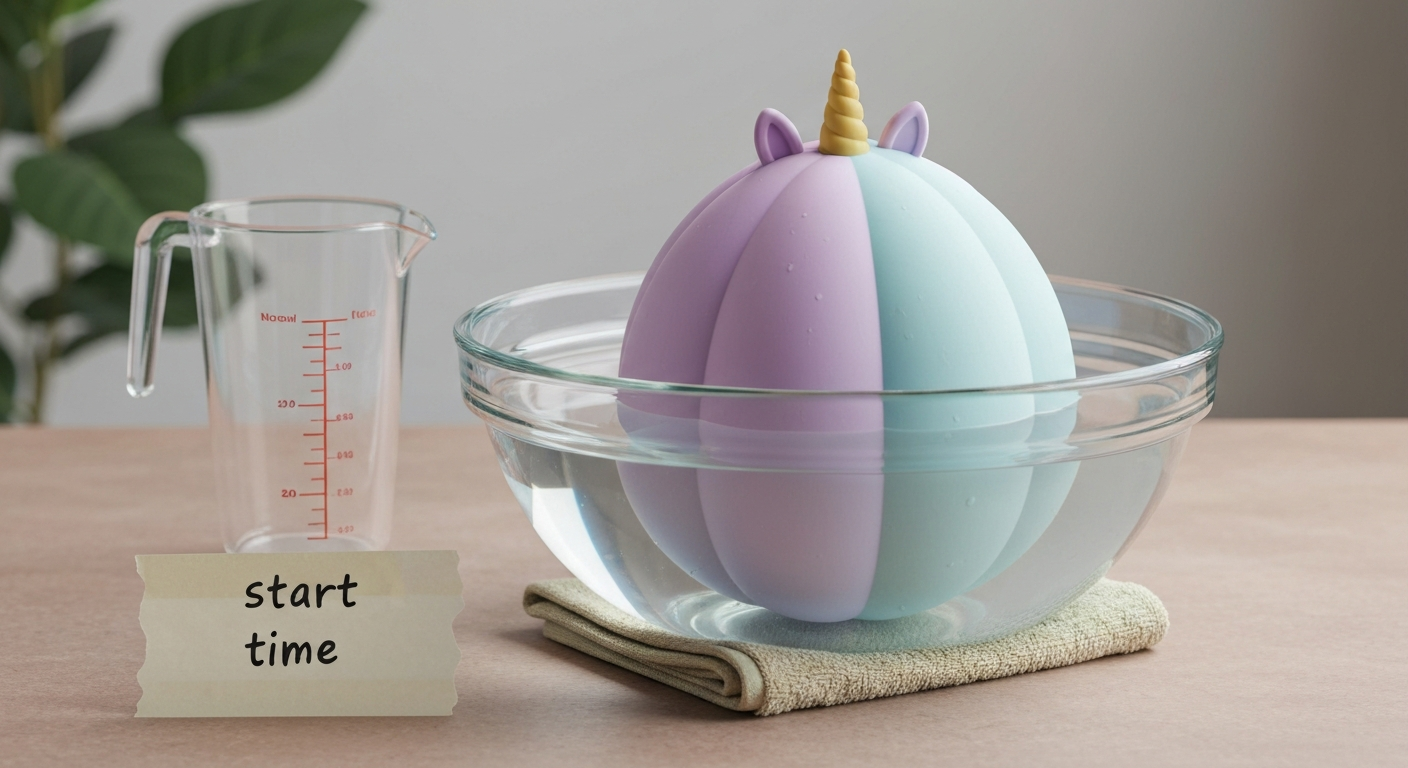
You probably have everything you need already. Here is exactly what to gather before opening the toy.
- A clear container or bowl deep and wide enough to fully submerge the toy with at least 1 cm of water above it — a standard cereal bowl works for small figures; a large mixing bowl or storage tub for anything bigger than a fist
- Plain tap water at room temperature (cold water slows absorption; very hot water can distort the shape)
- A measuring jug or cup so you can track roughly how much water you add
- A tray or folded towels placed under and around the container to catch overflow as the toy expands and displaces water
- Tweezers or a slotted spoon for moving the figure without tearing it once it is swollen and fragile
- Paper towels or a clean dry cloth for blotting the finished toy
- A marker and a piece of tape to label the container with the start time (helpful for tracking progress)
- Optional: a ruler for measuring growth at intervals if you want to see how fast it is expanding
Safety and child-care warnings, read this first
Water-expanding toys look harmless but carry real risks for young children and pets. The CPSC, the American Academy of Pediatrics (AAP), and poison control centers all flag these toys as a serious ingestion hazard for children under 5. U.S. Consumer Product Safety Commission (CPSC) warned consumers on March 19, 2024 to immediately stop using certain Tuladuo and Jangostor large water‑bead sets due to acrylamide levels that violate the Federal Hazardous Substances Act and advised disposing of affected products in the trash (do not use) CPSC warned consumers on March 19, 2024 about Tuladuo and Jangostor water‑bead sets. A bead or fragment that looks too small to matter can expand dramatically inside the digestive tract and cause a bowel obstruction requiring surgery. A national analysis of U.S. poison center calls recorded 20,279 water-bead ingestion contacts between 2019 and 2024, with numbers rising steeply each year. Clinical case reports document emergency admissions and surgical removals in infants and toddlers.
- Age recommendation: Most manufacturers rate these toys for ages 3 and up at minimum; many are labeled 5 and up. Treat any age rating on the packaging as the absolute floor, not a guideline.
- Adult supervision required: Do not leave children under 8 unsupervised during setup, growth, or play with these figures.
- Choking and ingestion: Do not allow young children or pets near the dry compact form or any broken-off fragments. If a child or pet swallows any part of the toy, call U.S. Poison Control immediately at 1-800-222-1222. Do not wait for symptoms.
- Skin and eye contact: Sodium polyacrylate can cause mild skin irritation and eye irritation. Wash hands thoroughly with soap and water after handling. If dry polymer dust or gel contacts eyes, rinse with clean water for at least 15 minutes and seek medical advice.
- Inhalation: Do not crush or grind the dry toy. Respirable dust from superabsorbent polymers is a respiratory hazard. Keep the toy intact.
- Non-toxic does not mean safe: 'Non-toxic' labeling (as required for toys) means the material is not acutely poisonous in small amounts by ingestion — it does not mean swallowing it is harmless. Physical obstruction is the danger, not chemical toxicity.
- CPSC safety standard: A federal water-bead safety standard took effect on March 12, 2026, setting performance, labeling, and acrylamide limits for water beads manufactured after that date. Check your toy's manufacture date on the packaging. If you have an older product from a brand flagged in CPSC warnings (such as certain Tuladuo or Jangostor bead sets), stop use and dispose of it.
- Pets: Keep cats and dogs away from both dry and hydrated figures. Ingestion by pets carries the same bowel-obstruction risk as for small children.
Manufacturer language decoded
Most packaging for these toys uses vague phrases like 'place in water and watch it grow' or 'allow to fully hydrate.' That tells you almost nothing useful. Here is what those phrases actually mean in practice, translated into a plain checklist you can follow step by step.
- 'Place in water' means fully submerge the toy — the entire figure must be underwater, not just resting in a shallow puddle. If any part sticks out above the surface, that part will not expand and you will get an uneven, lopsided result.
- 'Watch it grow' means check on it every few hours, but do not touch or reposition it during the first 8 hours. Handling a partially hydrated figure can tear it because the outer layers are soft while the core is still hard.
- 'Allow to fully hydrate' means wait at least 24 hours for small figures, 48 to 72 hours for medium and large ones. Pulling it out early gives you a hard-centered toy that looks swollen on the outside but is still dense inside.
- 'Use enough water' means fill the container so the water level stays above the toy even after it swells. As the toy absorbs water, the level drops. Add water once or twice a day to keep the toy submerged.
- 'Room temperature water' means roughly 18 to 24 degrees Celsius (65 to 75 degrees Fahrenheit). Cold water from the fridge significantly slows the process. Very hot or boiling water can distort the shape.
- 'Results may vary' is the manufacturer covering themselves for tap water mineral content, which genuinely does affect final size. Hard tap water with high mineral content swells the toy less than soft water or distilled water.
Step-by-step: how to grow a unicorn in water
Setup (5 minutes)
- Place your container on a tray or folded towel on a flat, stable surface away from direct sunlight and away from reach of pets or young children.
- Fill the container with room-temperature tap water. For a small unicorn figure (roughly the size of a matchbox), use at least 500 ml (about 2 cups). For a medium figure (palm-sized), use at least 1 litre (about 4 cups). You want enough volume that the water level will stay above the toy even after significant absorption.
- Gently place the dry compact unicorn into the water. Do not force or squeeze it. It should sink or sit on the bottom. If it floats, the air inside will escape within the first 30 minutes and it will settle.
- Note the start time on a piece of tape stuck to the container.
The first 8 hours
- Check the water level every 2 to 3 hours. As the toy absorbs water, the level in the container drops. Top it up with room-temperature water as needed to keep the toy fully submerged.
- Do not touch or reposition the figure during this phase. The outer foam is soft and stretchy but the core is still rigid. Pushing or prodding it now can cause uneven expansion or surface tears.
- You should see visible swelling within the first 1 to 2 hours — the figure will look noticeably puffier and the surface will change from dry and compressed to moist and slightly rubbery.
- If after 2 hours there is zero visible change, check that the toy is fully submerged and that the water is not too cold. Move the container to a slightly warmer room if needed.
Hours 8 to 24
- Continue topping up the water level once or twice. The toy is now soft enough to handle gently if you need to reposition it, but use tweezers or a slotted spoon rather than bare fingers squeezing the surface.
- By hour 8, most small unicorn figures will be 50 to 70 percent of their final size.
- By hour 24, most small figures are at or very close to full size. Carefully lift the figure from the water using your slotted spoon and place it on a clean towel. Blot gently — do not wring or squeeze.
Hours 24 to 72 (medium and large figures)
- Medium figures generally need 48 hours to reach full size. Large figures (larger than a hand) typically need the full 72 hours.
- Keep topping up the water. The container will lose a significant amount of water over three days — budget for refilling it once or twice a day.
- At 72 hours, remove the figure gently. It will be soft, squishy, and fragile. Handle it as you would a water balloon — support the whole shape rather than gripping one part.
Variations: growing dinosaurs, yetis, and large Megga models
The same core process applies to dinosaurs, yetis, and other water-expanding creatures in this toy family. The differences come down to size, container dimensions, and time. If you have grown a dinosaur before, the unicorn process is identical, and vice versa. For step-by-step grow a dinosaur in water instructions, see the grow a dinosaur in water instructions guide. The grow-a-dinosaur and grow-a-yeti toys use the same sodium polyacrylate foam chemistry, so the troubleshooting advice in this article applies equally to all of them.
The Dino World Megga Grow toys are where things change meaningfully. These are larger compressed figures, some packaging lists final sizes up to 600 percent of the dry starting size, and they need a bigger container and a longer soak. A standard cereal bowl will not cut it for a Megga Grow dinosaur. You need a container that holds at least 3 to 4 litres (a large mixing bowl or a deep storage tub), and you should plan for the full 72-hour soak rather than checking at 24 hours. The water displacement from a fully expanded Megga figure is substantial, so start with the container only about half full and add water steadily rather than filling it to the brim at the start.
For yeti toys, which tend to be medium-to-large in their final form, use a 1.5 to 2 litre container and a 48-hour soak as your baseline. The dense, chunky shape of most yeti figures means the core takes longer to hydrate than a flatter, thinner unicorn figure, so be patient even if the outside looks done.
| Toy type / size | Container size | Starting water volume | Expected full soak time |
|---|---|---|---|
| Small unicorn or dinosaur (matchbox-sized dry) | 500 ml bowl | 500 ml | 24 hours |
| Medium unicorn or yeti (palm-sized dry) | 1–1.5 litre bowl | 1 litre | 48 hours |
| Large figure (fist-sized dry) | 2–3 litre bowl | 2 litres | 72 hours |
| Dino World Megga Grow | 3–4 litre tub | 2 litres (top up regularly) | 72 hours |
| Multiple small figures at once | 2 litre bowl minimum | 1.5 litres | 24–48 hours |
Brand and model notes
Grow-Your-Own Unicorn kits
As noted earlier, 'Grow-Your-Own Unicorn' covers at least three different product types. For the water-expandable foam figure version, the instructions in this article apply directly. One quirk I have seen with several versions of this kit: the packaging shows a much more vivid, detailed unicorn than the foam figure actually looks once expanded. The dry compact is always a simplified, slightly abstract shape. That is not a defect, it is just how the compression process works. The surface detail increases a lot as the foam absorbs water and the mold shape becomes clearer, but expect a soft, slightly rounded result rather than a crisp figurine.
Dino World Megga Grow
JA-RU's Megga Grow line (sold under 'Dino World' and similar branding) is specifically designed for larger, more dramatic expansion than the standard compact figures. The manufacturer instructs users to place the egg or compressed figure in water and wait; early cracking or movement of the outer shell is normal and expected within the first few hours. What surprises many people is that the outer layer softens and peels back as the inner figure expands, do not try to remove the outer layer manually early on, as you will damage the figure underneath. Let the expansion push it apart naturally. These toys genuinely need 72 hours and a large, deep container. Check the Dino World Megga Grow instructions page on this site for model-specific diagrams and timing.
Crayola Grow-With-Me variants
The Crayola Grow-With-Me Easel is a completely different product category, it is a physical art easel with height-adjustment features for growing children, not a water-expanding toy. It does not belong in a water container and these instructions do not apply to it. If you landed here looking for Crayola Grow-With-Me Easel setup help, you need the assembly instructions for that product specifically. Do not put any part of an easel in water.
Timing and size expectations
| Time in water | Small figure (matchbox dry) | Medium figure (palm-sized dry) | Dino World Megga Grow |
|---|---|---|---|
| 1 hour | Visibly puffier, surface soft, ~15–20% larger | Slight surface softening, ~10% larger | Outer shell beginning to crack or shift |
| 8 hours | ~50–70% of final size, shape recognizable | ~40–60% of final size | ~30–40% of final size, inner figure emerging |
| 24 hours | At or near full size — remove and blot dry | ~70–80% of final size, needs more time | ~60–70% of final size |
| 72 hours | Fully expanded (if left in); diminishing returns after 24 hrs | At or near full size | At full size — remove and blot dry |
A word on what 'full size' actually means: manufacturers often quote expansion ratios like '400% to 600% of original size' on the packaging. That refers to volume, not length. A toy that is 600% bigger in volume only looks about 1.8 times longer in each dimension because volume scales as the cube. So a 3 cm dry figure might reach roughly 5 to 6 cm fully expanded, impressive but not as dramatic as the number on the box implies. If you are using distilled or filtered water, you will likely get slightly more expansion than with hard tap water because mineral ions interfere with the polymer's ability to absorb water. Academic and lab protocols recommend gravimetric equilibrium‑swelling measurements (dry and swollen weights) and recording water type, temperature, and ionic strength because salts and temperature materially change hydrogel swelling Protocol: Equilibrium Swelling Ratio (gravitimetric) and swelling kinetics (Biomaterials engineering guide).
Troubleshooting common problems
The toy is not growing at all
First, check that it is fully submerged. A toy resting on the bottom of a bowl with 1 cm of water barely covering it will absorb water very slowly and unevenly. Second, check your water temperature, cold water (below about 15 degrees Celsius) dramatically slows absorption. Move the container to a warmer room. Third, give it more time. Some compressed figures have a harder outer coating that takes 2 to 3 hours before you see any visible change. If there is still zero change after 4 to 5 hours in warm, fully submerging water, the toy may have dried out past its usable state (very old stock sometimes loses its absorbency).
The toy came out lopsided or misshapen
This almost always means part of the figure was not fully submerged during the soak. The solution is to carefully return it to a larger container with more water and leave it another 12 to 24 hours, making sure the under-expanded side is facing down into the deepest part of the water. You can also try gently repositioning the figure every few hours once it is soft enough to move (after the first 8 hours). Sometimes, though, a figure that dried out in an uneven position before you bought it will never fully recover its original shape.
The toy feels slimy or the water turned cloudy
Sliminess after 24 to 48 hours is normal, the outer surface of the hydrated polymer is gel-like. Cloudiness in the water is usually fine if it appears within the first few hours and is milky or slightly white; that is loose polymer particles or coating material releasing from the surface. However, if the water turns green, yellow, or develops an odor after 48 to 72 hours, that is a sign of bacterial or mold growth in the water. Research into hydrogel materials confirms that moist, nutrient-free hydrogels can support microbial biofilm formation over time. Remove the toy, rinse it under clean running water, and change the water in the container. Do not leave the toy sitting in stagnant water for more than 72 hours.
The toy tore while I was handling it
A fully hydrated SAP foam figure is fragile, it has roughly the structural strength of a soft gelatin dessert. Small tears are usually not repairable. For display purposes, a small tear on the underside or back may not be visible. Larger tears can sometimes be minimized by gently pressing the edges back together before the toy dries; as the polymer dries slightly and contracts, the edges may re-join. Prevention is easier than repair: use a slotted spoon or tweezers, and support the whole figure when lifting rather than pinching one spot.
Care, display, and storage
Once your unicorn is fully expanded, you have a few options for what to do with it. For display, blot it gently with a paper towel and place it on a dry surface. It will slowly lose water over the next several days and shrink back down as it dries out. This is normal and reversible, you can re-expand it by putting it back in water. For longer-term display in its expanded form, keep it in a shallow container with a small amount of fresh water (enough to touch the base but not fully submerge it) and replace the water every 2 days to prevent microbial growth. Clean the figure with plain soap and water if it develops any surface residue; the CDC advises that plain soap and water is generally sufficient for cleaning toys used by children, and you should avoid bleach or alcohol-based disinfectants on items that children may mouth.
For storage, allow the figure to dry out completely (1 to 3 days in open air) back to its compact form, then store it in a sealed bag or container in a cool, dry place. Do not store it in a sealed container while still wet, mold growth in a sealed humid environment is a real risk. A fully re-dried figure can be re-expanded many times without significant loss of quality, though repeated cycles do gradually reduce the maximum expansion.
Disposal and environmental guidance
When you are done with the toy for good, let it dry out completely and dispose of it in your regular household trash. Do not flush hydrated SAP figures down the drain or toilet. A hydrated bead or figure can re-expand inside plumbing and cause blockages in household pipes and downstream wastewater equipment. Small dry quantities of SAP are generally acceptable in normal solid waste disposal according to most product safety data sheets, but always check your local waste regulations. There are no standard home composting or recycling streams for these polymer toys.
Finding your specific manual and replacement parts
If your toy came with a printed instruction sheet that has been lost, or if you want model-specific timing and container guidance, the best first step is to search the manufacturer's website using the product name and item number printed on the packaging. JA-RU (maker of Megga Grow and Magic Grow lines) lists product information on their website and through major retailers. For 'Grow-Your-Own' branded kits, the brand and retailer vary widely, look for the manufacturer name in small print on the back of the packaging, not just the product name. This site has dedicated walkthroughs for the Grow-Your-Own Unicorn kit, the Dino World Megga Grow, and the grow-a-dinosaur and grow-a-yeti toys if you need model-specific step-by-step guidance for those close relatives of this unicorn toy.
FAQ
What is this article about and who is it for?
Step‑by‑step, practical instructions for safely "growing" water‑expanding toy figures (unicorns, dinosaurs, yetis) from compressed pellets/sponge/hydrogel, written for DIY hobbyists, parents, and beginners. It focuses on safe preparation, exact water amounts and timing, troubleshooting common failures, care/display/storage, disposal/environmental guidance, and how to find model‑specific manuals and parts. It does not cover crystal/seed‑growing kits or unrelated chemistries—confirm your kit is a water‑expandable hydrogel/foam type before following these steps.
How do I identify the kit type so I use the correct procedure?
Check the product packaging and instructions. Water‑expandable toy kits indicate compressed pellets/figures or 'hydrogel/superabsorbent' on the label and say 'place in water' or 'watch it grow.' If packaging mentions seeds/soil, salts/crystals, or a growth solution, it’s a different kit and needs different instructions. When in doubt, look for the material name (sodium polyacrylate, superabsorbent polymer, compressed foam) or the model name (Dino World Megga Grow, Grow‑Your‑Own Unicorn, Crayola Grow‑With‑Me variants) and consult the manufacturer manual listed on their website.
What exact supplies do I need?
1) Plastic or glass container (large enough for the piece to expand freely). 2) Measuring cup or kitchen scale. 3) Clean tap water (room temperature) or distilled water if specified. 4) Timer or clock. 5) Paper towels and a tray for draining. 6) Gloves and eye protection if you will handle dry pellets/dust. 7) Tongs or a spoon. 8) Trash bag for disposal. 9) Phone/camera for photos if desired. Keep small children supervised and out of reach of unhydrated beads and dust.
Step‑by‑step foolproof setup (measurements, times, and handling) for a single compressed toy pellet or small figure
1) Confirm the kit type is water‑expandable hydrogel/foam. 2) Use a clean container that is at least 3× the final expected size of the toy to allow expansion and water circulation. 3) Measure water: for small compressed figures (typical packaged pellet ~1–5 g dry), use 200–500 mL (about 1–2 cups) room‑temperature tap water. For larger compressed eggs/figures (10–30 g dry), use 1–4 L (about 4–16 cups). If packaging gives a water volume, follow that; otherwise use the above as a starting range. 4) Place the dry pellet/figure gently into the water. Submerge if it floats by weighting with a clean spoon. 5) Start the timer. Expect visible change within 1–6 hours; do not remove until the manufacturer’s minimum time or 24 hours has passed. 6) For many kits, full growth occurs in 24–72 hours; check periodically but leave undisturbed for at least the first 24 hours. 7) After the initial swelling period, drain excess water through a colander onto paper towels and let the toy rest for 10–30 minutes to reach final shape. 8) Transfer to display/drain tray. Rinse hands after handling. Keep product away from children under 5 and pets while drying or stored hydrated.
Brand/model notes and any special instructions for specific kits
- Dino World Megga Grow / Megga Grow eggs: larger compressed eggs typically require 1–4 L of water and 24–72+ hours for full hatching; use a deep bowl and avoid frequent handling while cracking occurs. - Grow‑Your‑Own Unicorn (common mass‑market variants): many are small compressed foam/hydrogel pellets—start with 200–500 mL water per pellet; expect 24–48 hours for most visible growth. - Crayola Grow‑With‑Me variants: follow package amounts; some Crayola sets include color dye packets—do not taste or allow children to mouth dyed water; rinse toys thoroughly before display. Always read any included insert. If the kit lacks clear instructions, follow the general step‑by‑step above and use conservative water volumes (more water speeds hydration but wastes water; too little slows or distorts growth).
What timing and size outcomes should I expect (concise reference)?
Typical timing/size expectations (approximate; depends on product): - Small pellet/figure (dry 1–5 g): initial expansion 1–6 hours; usable size 24–48 hours; final size 5–20× dry volume. - Medium egg/figure (dry 10–30 g): initial cracking/visible growth 6–24 hours; full size 48–72+ hours; final size 10–50× dry volume. - Large novelty eggs/megga (dry >30 g): visible change 12–48 hours; full expansion 72+ hours. Environmental factors: warmer water speeds swelling; high‑salt water reduces swelling. Expect the manufacturer’s stated times to be optimistic; allow extra time to reach full stable size.